Landscaping
Fall Armyworms in Fort Worth Lawns
Buffalo Outdoor • September 2026 • Fort Worth, TX • 8 min read
Short Answer: Fall armyworms are caterpillars that arrive in large numbers in late summer and can strip a Fort Worth lawn to stubble in a day or two. The damage looks like the lawn was scalped, and it advances across the yard like a front rather than appearing in patches. Confirm them by parting the grass at the edge of the damage at dawn or dusk, or by pouring soapy water over a square yard to drive them up. Speed matters more than product choice, because armyworms eat leaf tissue and usually leave the crowns and roots alive.
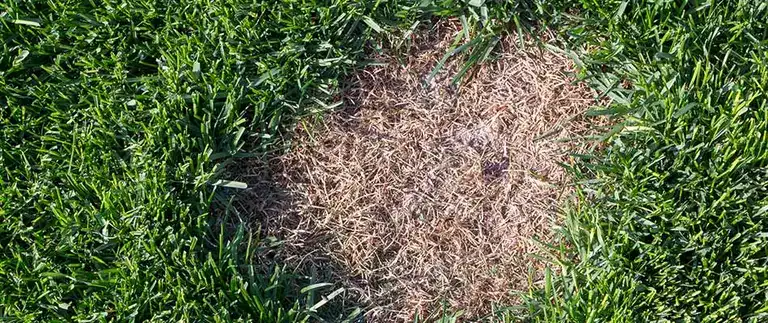
If you mowed on Saturday and by Tuesday a section of the lawn looks like it was cut to the dirt, you are almost certainly dealing with fall armyworms. Very little else in a North Texas yard produces damage that fast.
We get a run of these calls every year once the weather turns, and the single biggest factor in how a lawn comes out is how quickly the homeowner recognized what they were looking at. This is one of the few lawn problems where a day genuinely matters.
What They Are and Why Now
Fall armyworms are the larvae of a moth that does not survive our winters in most of the state. Populations build further south and move northward across the season in successive generations, arriving here in numbers by late summer.
The moths lay egg masses on almost any vertical surface, often fences, house walls, eaves, and the undersides of leaves, frequently in fuzzy grey patches. Each mass can hold hundreds of eggs.
The caterpillars that hatch eat very little at first, which is why nobody notices them, then grow rapidly. The last few days of that development is when they consume the overwhelming majority of what they will eat in their lives.
That is the mechanism behind the overnight disaster. The population was there for two weeks doing nothing visible, then hit the stage where it eats everything.
What the Damage Looks Like
The most reliable signature is speed combined with an advancing edge. The name is apt: they move across a lawn in a front, so you commonly see healthy grass, a boundary, then chewed stubble behind it. Come back a day later and the boundary has moved.
Early damage can look like drought. Blades take on a slightly transparent, papery appearance where the caterpillars have scraped tissue without cutting through. That windowpaning is the earliest visible sign and it appears before the lawn browns.
Look for frass at soil level as well, small dark green or brown pellets. A lawn with a heavy population has noticeably gritty debris at the base of the grass.
Birds are a useful early warning. If grackles are working a section of your lawn intently and repeatedly, they are eating something, and in September it is often this.
Two Ways to Confirm Them
Armyworms feed most actively in the early morning and toward evening, sheltering down in the thatch during the heat of the day. Looking at noon and finding nothing proves very little.
The simplest check is to go out at dawn or dusk, get down at the edge of the damage where green meets chewed, and part the grass with your fingers. If they are there you will see them. They are green to brown, up to roughly an inch and a half when mature, with stripes running the length of the body and a pale inverted Y on the head.
The more reliable check is the soap flush. Mix a couple of tablespoons of dish soap into a gallon or two of water and pour it slowly over a square yard at the edge of the damage. Within a few minutes anything living in that thatch comes to the surface. It is genuinely startling the first time.
Why Speed Beats Product Choice
Here is the part that determines the outcome.
Armyworms eat leaf tissue. On established turf they generally do not destroy the crowns or root system, which means a lawn treated promptly usually recovers completely, greening back over the following few weeks with water and appropriate feeding.
What turns a recoverable event into real damage is time. A lawn stripped bare and then left in September heat with no leaf tissue to photosynthesise is under severe stress, and on already weak turf that stress kills plants outright. The difference between treating on day one and day five is frequently the difference between full recovery and resodding.
Smaller caterpillars are also considerably easier to control than large ones, and the largest are close to done eating anyway. Catching them early wins on both counts.
Expect a Second Wave
Something we want Fort Worth homeowners to expect rather than be surprised by.
Because generations overlap and moths keep laying, it is entirely normal to knock down one infestation and see another two or three weeks later. Homeowners frequently read that as a failed treatment when it is actually a new hatch.
So keep checking through the autumn rather than assuming one treatment closes the matter. A quick look at dawn along the edges of the lawn every week costs nothing.
Neighboring properties matter too. If the yard next door is untreated and infested, yours is receiving a steady supply, and this is one of the genuinely reasonable moments to mention it over the fence.
What They Will and Will Not Eat
Knowing their preferences helps you predict where to look.
Fall armyworms favor grasses. Bermuda is the usual casualty around Fort Worth and they work through it enthusiastically. They also feed on ryegrass and a range of pasture grasses, which is why properties bordering fields or greenbelts sometimes see them arrive from the edge inward.
St. Augustine is generally less preferred than Bermuda, though a large enough population will eat it too. On a mixed lawn you may see the Bermuda sections chewed while the St. Augustine holds.
They are much less interested in established shrubs and trees, so landscape beds adjacent to a stripped lawn usually come through untouched.
Helping the Lawn Recover
Once the caterpillars are handled, the lawn needs support rather than heroics.
Water is the priority. Grass that has lost most of its leaf surface cannot produce energy efficiently, so keeping it adequately watered while it regrows is the main thing you can do. Deep and less frequent rather than daily light sprinkling.
Feed moderately if the lawn was not recently fertilised, bearing in mind we are moving toward the end of the growing season for warm season grass. This is support, not a growth push.
Raise the mowing height slightly and hold off mowing until there is enough leaf tissue to justify it. Cutting a recovering lawn short removes exactly what it needs to rebuild.
Most properties recover fully within three to four weeks in September provided they got water. Lawns that went into the event already thin or drought stressed take longer and sometimes need overseeding or patching.
Ruling Out the Look-Alikes
Not every brown patch in a Fort Worth September is armyworms, and treating the wrong cause wastes the rest of the season.
Grub damage is the important distinction because the response is completely different. Grub damaged turf lifts away like loose carpet, since the roots have been eaten underneath. Armyworm damage leaves roots intact, so the turf stays firmly anchored even where the blades are gone.
Drought stress follows a logic you can see. It shows first on slopes, along south facing walls, and in the strip beside pavement where reflected heat bakes the soil, and it maps onto wherever irrigation coverage is thin. It does not advance across the yard as a front.
Chinch bugs favor the hottest, sunniest strips and produce irregular yellowing that spreads outward, and the grass genuinely dies rather than being chewed short.
And simple scalping from mowing too low over an uneven area browns out in a way that can look alarming with no insect involved at all.
The distinguishing feature of armyworms is the speed and the moving edge. If the boundary is in a different place tomorrow, it is caterpillars.
What to Do Next
Walk your lawn at dawn or dusk this week, particularly along the edges and anywhere that looks slightly off color. Part the grass at the border of anything suspicious, and if you are unsure, do the soap flush on one square yard.
Check your fence line and the shaded side of the house for egg masses while you are out there.
If you find them, act that day rather than that weekend. If you would rather have someone handle it quickly, Buffalo Outdoor serves Fort Worth, Keller, Aledo, Saginaw, Benbrook, White Settlement, Lake Worth, and the surrounding communities. Call 817-349-0580 or visit buffalooutdoor.com.
Here is what to expect. We will confirm what we are dealing with before treating, because armyworm damage and drought stress look similar from the street and only one is fixed by chemistry. We will tell you honestly that a second wave is possible, and we will talk about what the lawn needs to recover rather than only what it needs to stop being eaten.