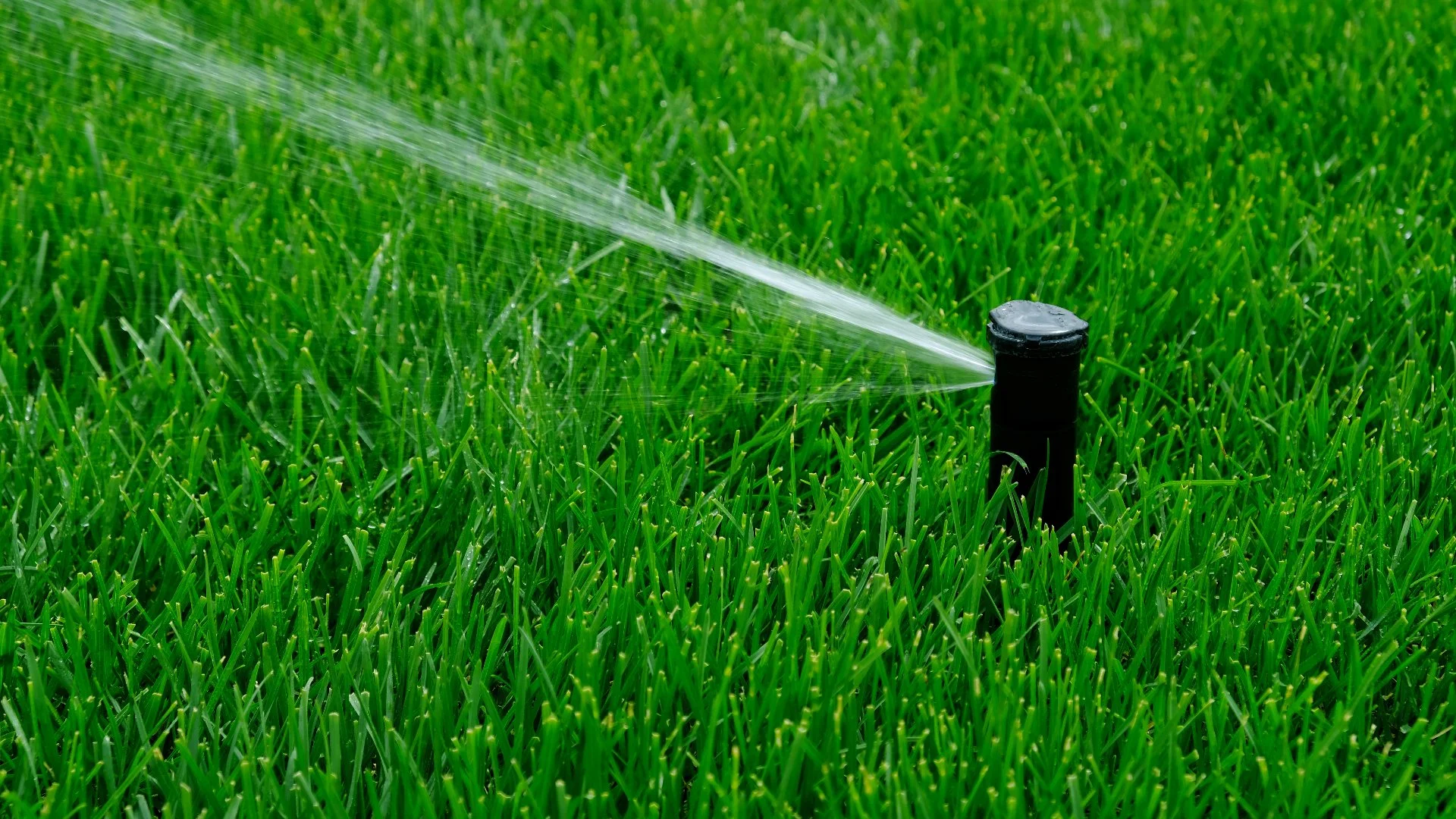
Short Answer: The right watering schedule for a North Texas lawn in summer is once or twice per week, in the early morning, applying about an inch of water total per week including rainfall. The single biggest mistake we see is watering daily for short bursts, which trains roots to stay shallow where they bake in July. Deep, infrequent watering using a cycle-and-soak approach pushes roots down into cooler soil and produces a lawn that handles 100-degree days without going crispy. Here is exactly how we set it up for Fort Worth, Keller, Aledo, and Benbrook properties.
If your lawn looks fine in May and rough by late July, the most likely culprit is your watering schedule. We see this every summer. Homeowners who set their controllers to run 15 minutes every morning and assume that is “watering deep” end up with brown patches, crispy edges, and lawns that need rescue applications in August.
The mechanics are simple once you understand them. Across Fort Worth, Keller, Aledo, Benbrook, and the surrounding North Texas area, here is exactly how to water for the heat we are about to face.
How Much Water North Texas Lawns Actually Need
The rule of thumb that holds up across our area is one inch of water per week through spring, and one to one-and-a-half inches per week through the peak of summer. That total includes whatever rainfall you got, not on top of it. If you got an inch of rain Tuesday night, you do not water the rest of the week.
For St. Augustine, the high end of that range is right. St. Augustine is the thirstiest of the warm-season grasses common in our area. Bermuda and Zoysia tolerate less. Across most Fort Worth area properties, one inch per week is the baseline target with adjustments based on grass type, exposure, and how hot the week is forecast to be.
That one inch should arrive in one or two deep applications, not seven shallow ones. The reason is what happens underground when you change the schedule.
Why Deep and Infrequent Beats Daily and Shallow
Grass roots grow toward water. If water sits in the top inch of soil because that is all the irrigation reaches, the roots stay in the top inch. That root zone is exactly where North Texas soil bakes hardest in July. Surface temperatures during a 100-degree afternoon can run 130 to 140 degrees. Shallow-rooted grass cannot find water once the top inch dries out.
Deep watering soaks the soil 4 to 6 inches down. Roots follow the moisture downward over time. By the second or third week of a deep-watering schedule, the lawn has measurably deeper roots than it had on a daily-shallow schedule, and the difference shows up the first time we hit a real heat wave.
The visible signal is dramatic. Properties that switched their schedule in May typically look noticeably better by August than identical neighboring properties that did not. Same grass, same soil, same exposure. Different roots.
The Morning Watering Rule
Run your irrigation between 4 AM and 9 AM, never later. Two reasons.
First, evaporation. Watering at noon means losing 30 to 50 percent of what comes out of the sprinkler to evaporation before it reaches the soil. Morning watering loses almost none.
Second, disease. Brown patch, gray leaf spot, and other fungal diseases that hit North Texas lawns hardest all need extended leaf wetness to spread. Evening or nighttime watering leaves the lawn wet for 8 to 12 hours overnight, which is exactly the window the fungus needs. Morning watering lets the lawn dry out by midday and stays dry into the night.
If your current schedule runs at sunset because that is when you remembered to set it five years ago, this single change will make a measurable difference in your lawn’s disease pressure by August.
Cycle and Soak: The Technique Most Homeowners Have Not Heard Of
This one matters specifically for North Texas because of our heavy clay soils. Most properties cannot accept water as fast as a sprinkler delivers it. Run a zone for 20 minutes straight and the last 10 minutes runs off into the street or pools in low spots because the soil cannot infiltrate that fast.
Cycle and soak is the fix. Instead of running each zone once for 20 minutes, run it three times for 7 minutes each, with 20 to 30 minutes between cycles. The first cycle wets the surface. The break lets the water soak in. The second cycle adds more without runoff. The third tops it off.
Total water applied is the same. Total water absorbed is dramatically higher. On clay soils, cycle and soak can be the difference between a properly hydrated lawn and one that looks irrigated but is actually water-starved.
Most modern irrigation controllers support cycle and soak as a built-in setting. Older controllers can do it manually by setting multiple short start times. The 10 minutes spent programming this once at the start of summer pays off across the whole season.
How to Tell If You Are Watering Enough
Three simple checks let you know whether your schedule is actually delivering what the lawn needs.
The tuna can test. Place six to eight empty tuna cans across a single zone before a watering cycle. Run the cycle as you normally would. Measure the water depth in each can afterward. You want about half an inch per cycle if you are watering twice a week, or close to an inch if you are watering once. Cans should also be close to equal depth across the zone; if some have twice as much as others, you have a coverage problem.
The screwdriver test. Push a long screwdriver into the soil in your lawn the morning after watering. It should slide in easily 4 to 6 inches deep. If it stops at an inch or two, your watering is shallow and roots will be too.
The footprint test. Walk across the lawn and look back. If your footprints stay visible for more than an hour, the grass is moisture-stressed and the blades cannot spring back. Time to water deeper.
Adjusting Through the Season
The schedule should change with the weather, not run the same all summer. Here is what we adjust on the properties we manage.
Early May. Most lawns need very little supplemental water yet. Once a week of about three-quarters of an inch is plenty unless we hit a dry stretch.
Late May through June. Bump to one inch per week. Watch for the first 90-degree days and add a second cycle if needed.
July and August. One to one-and-a-half inches per week, split into two deep cycles. Skip cycles after significant rainfall.
September. Daytime temperatures start to break. Drop back to one inch per week, then less as nights cool.
October. Most lawns need almost no supplemental water by mid-October as growth slows.
Smart irrigation controllers handle these adjustments automatically using weather data and historical evapotranspiration rates. The investment ($150 to $400 for a residential controller) typically pays back within two summers through water savings alone, before you factor in the lawn health benefits.
Common Mistakes We See Every Summer
Watering every day, even for short cycles. Trains shallow roots. Wastes water. Promotes disease.
Watering at the same time every day regardless of weather. Properties on a single program that does not respond to rain often waste hundreds of dollars per summer and stress the lawn during wet stretches.
Watering only the front yard. Backyards often get less attention and develop chronic stress patterns that show up as thin or weedy areas over time.
Trusting the sprinkler system without auditing coverage. Heads that are angled wrong, blocked by shrubs, or running at the wrong pressure produce uneven coverage that maps directly to brown patches by August.
Ignoring drainage. Areas where water pools after rainfall need different treatment than areas where it drains fast. Watering both the same way produces problems in both zones.
Watering immediately after fertilizer or weed control without checking the product label. Some products need water-in. Others need 24 to 48 hours of dry conditions to activate properly. Timing matters.
What This Looks Like in Practice
For a typical Fort Worth area St. Augustine lawn in July, the workable schedule looks like:
Monday and Thursday, 5 AM. Cycle and soak: 7 minutes on, 25 minutes off, repeat twice for each zone. Total runtime per zone: 21 minutes of irrigation across about an hour and a half.
Total water delivered: roughly one inch per week.
Skip any cycle within 48 hours of half an inch or more of rainfall.
For Bermuda or Zoysia, drop one of those days during weeks where temperatures are not in the high 90s.
The schedule looks more complicated than “run for 15 minutes every morning” because it is. The results justify the complexity by August when your lawn is still green and the neighbors’ lawns are crispy.
What to Do Next
If you would like a hand auditing your current sprinkler coverage, dialing in a cycle and soak schedule for your specific soil and grass type, or just having someone walk the property and tell you honestly what is going on, we are glad to come out. We work with properties across Fort Worth, Keller, Aledo, Benbrook, and the surrounding North Texas area. Reach out and we will get you on the schedule.