Short Answer: Armyworm outbreaks hit North Texas lawns most years between mid-July and early September. A heavy infestation can strip a Bermuda lawn down to stems and bare crowns in 48 hours. The early signs are spotty browning, increased bird activity in the lawn, and damp areas that look chewed. Treatment with a contact insecticide labeled for armyworms works rapidly when applied in early morning or evening. Catching them in the first 24 hours of visible damage prevents most of the loss. Catching them late means a fall renovation. Here is exactly what to watch for.
If you have lived through an armyworm outbreak on a Fort Worth area lawn, you remember it. A perfectly healthy Bermuda yard can look like a chewed carpet in two days. Properties that catch armyworms early lose a few patches. Properties that catch them late often need full sod replacement.
Here is what to watch for this week and what to do if you see the signs.
What Armyworms Are and Why They Hit North Texas
Armyworms are the larval stage of several moth species, most commonly the fall armyworm in our area. The adult moths fly in from southern regions in summer, lay eggs in lawn turf, and the larvae hatch and begin feeding within a week.
What makes armyworms uniquely damaging is their behavior. They feed in groups (hence “army”), can produce 50 to 100 larvae per square foot in heavy outbreaks, and consume grass aggressively. A single larva can eat its weight in turf every day, and large populations can defoliate a lawn faster than the grass can regrow.
North Texas typically sees the first wave between mid-July and early August. A second wave often follows in September. Heavy rain after dry stretches creates ideal conditions for outbreaks because the rain attracts moths to lay eggs and the soft soil aids larval development.
The Early Warning Signs
Patchy Browning That Spreads Quickly
Armyworm damage starts as small irregular brown areas that look like drought or disease damage. The distinguishing factor is rapid spread. Drought patches grow slowly over weeks. Armyworm patches can double in size overnight.
Increased Bird Activity
Robins, mockingbirds, and other birds know exactly where armyworms are and will feed on them aggressively. If your lawn has more bird activity than usual, especially birds repeatedly returning to the same areas, that is a strong indicator.
Visible Larvae at Ground Level
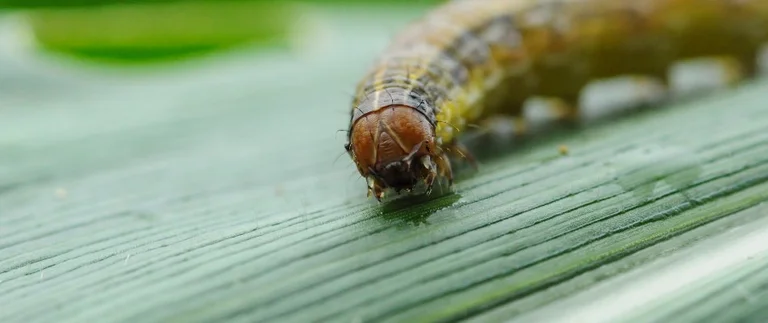
Part the grass in a suspicious area and look at the soil surface. Armyworm larvae are tan to dark green, with a distinct light stripe running down each side. They are about one inch long when fully grown. Small populations can be hard to spot. Large populations are unmistakable once you look.
Frass at the Soil Surface
Active armyworm feeding produces small dark green or brown pellets (frass) at the base of grass plants. Looking at the thatch level in damaged areas often reveals visible frass.
The Drench Test
Mix a tablespoon of dish soap into a gallon of water and pour it over a square yard of suspicious area. Wait two to three minutes. Armyworms will surface to escape the soap solution. Counting what comes up tells you the population density.
Treatment Options
Contact Insecticides
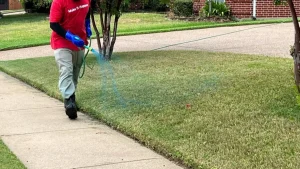
Several products labeled for armyworms work rapidly. Active ingredients including bifenthrin, lambda-cyhalothrin, and others provide effective knock-down within hours of application. Spray in early morning or evening when armyworms are most active and temperatures are below 85 degrees.
Water the product in lightly to reach the soil-canopy interface where armyworms feed. Avoid heavy watering that washes the product through the canopy.
Biological Options
Bt (Bacillus thuringiensis) products specifically labeled for caterpillars work against armyworm larvae. Application timing is more critical than with contact insecticides because Bt needs the larvae to ingest the product. Apply at dusk when armyworms begin feeding.
Bt is pollinator-safe and selective to caterpillar-stage insects, which makes it a preferred choice for properties with sensitive surrounding landscape.
Beneficial Nematodes
Some nematode species parasitize armyworm larvae. These are a slower response than chemical treatment but useful for repeat-pressure properties as part of a longer-term strategy.
Timing Matters More Than Product Choice
The single most important factor in armyworm response is speed. The same treatment applied on day one of an outbreak produces dramatically better results than the same treatment applied on day three. The grass that has not been chewed yet is the grass you can save.
This is why we recommend regular property walks during outbreak season and immediate action on any suspicious damage. Waiting “to see what happens” with armyworms usually means seeing the whole lawn damaged.
What Happens After Treatment
Effective treatment stops feeding within hours. The lawn looks worse for a few days as already-damaged grass dies back. Then the surviving grass and crowns begin recovery.
Bermuda recovers from armyworm damage relatively well if crowns are intact. Light damage often regrows within two weeks. Moderate damage may take a month. Severe damage where crowns were destroyed may need sod or seed in fall.
St. Augustine recovery is slower and less reliable. Severe St. Augustine damage often requires replacement.
What Increases Armyworm Pressure
Properties next to wooded areas, pastures, or untreated landscape often see heavier pressure because the moths concentrate in those areas. Heavy nitrogen applications during summer can attract egg-laying moths to a lawn that is putting out lush new growth. Wet conditions following extended dry stretches create ideal egg-laying conditions.
Frequently Asked Questions About Armyworms
How fast can armyworms damage a lawn?
Severely damaged lawns can show visible defoliation within 24 hours of an active outbreak. Full lawn damage in 48 to 72 hours is common.
Will the lawn come back on its own?
Bermuda usually recovers from moderate damage. St. Augustine recovery is less reliable. Severe damage requires renovation.
Are armyworms dangerous to pets or kids?
The worms themselves are not directly harmful. Treatment products should be applied per label and re-entry intervals respected.
How often should I check during outbreak season?
Walk the lawn every two to three days during July and August. The drench test once a week in suspicious areas catches early infestations.
Can I prevent armyworms?
Prevention is difficult because the moths fly in from elsewhere. Healthy turf with good cultural practices resists damage better. Rapid response to early signs is the most effective strategy.
What to Do This Week
Walk your lawn carefully looking for the signs above. Do the drench test in any suspicious areas. If you find armyworms, treat immediately. Do not wait. The 24 hours between detection and action decide how much lawn you save.
What to Do If You Already Lost Lawn to Armyworms
If armyworms hit before you caught them and you are looking at significant defoliated areas, the response depends on damage severity. Bermuda with intact crowns will recover with consistent watering and patience over four to six weeks. Bermuda with destroyed crowns will need fall renovation. St. Augustine that lost more than 30 percent of canopy density usually needs sod replacement in fall.
While the lawn recovers, water consistently, hold off on fertilizer for two weeks, and protect the area from foot traffic. Aggressive intervention beyond pest control typically makes recovery slower, not faster.
How Buffalo Outdoor Handles Outbreak Season
Our crews walk customer properties during outbreak season specifically looking for early armyworm signs. Catching the first day of damage is the difference between a small spot to treat and a full lawn loss. Customers on our service often see issues identified before they are even aware anything is wrong.
This is one of the situations where regular professional attention pays off most clearly. The 30 minutes a crew spends walking your property each visit is exactly the kind of attention that catches armyworms before they become a crisis.
Pressure Patterns We See Across Tarrant County
Some neighborhoods consistently see heavier armyworm pressure than others. Properties near horse pastures west of Aledo, near the Trinity River corridors, or backing up to wooded areas tend to get hit harder and earlier. Properties in tighter suburban developments often see lower pressure but still get hit during heavy outbreak years.
The single best predictor we have for any given year is rainfall in mid-July. Wet mid-July weather typically produces a heavier outbreak two to three weeks later. When we see those weather patterns, we increase scouting frequency on customer properties.
What to Do Next
If you want help with any of this, we are glad to come walk the property with you. We will look at your specific lawn, identify what is doing well and what needs attention, and tell you honestly what we recommend.
Call us at (817) 799-6823 or visit buffalooutdoor.com to request your quote. As the fastest growing and highest rated outdoor services company in Tarrant County, with awards including Best of Fort Worth in 2022, 2024, and 2025, and Inc. 5000 recognition in 2023, we bring a level of expertise and accountability that is hard to match. Our 100% satisfaction guarantee means if we cannot make it right, you pay nothing. We serve homeowners across Keller, Aledo, Saginaw, Benbrook, Fort Worth, Southlake, Roanoke, Trophy Club, North Richland Hills, and communities throughout the area.