Short Answer: Chinch bug season in North Texas runs from late May through September, with peak damage in June and July when populations explode in hot, dry weather. The damage looks deceptively like drought stress: irregular yellow then brown patches in the sunniest parts of the lawn that expand fast. The difference is that drought-stressed grass greens back up within a day or two of deep watering. Chinch bug damage gets worse no matter how much you water, because the bugs are injecting toxin into the blades. The soap flush test confirms them in five minutes. Caught early, a single targeted treatment ends the outbreak. Caught late, you may be replacing sod.
If you live in Fort Worth, Keller, Aledo, or Benbrook and you have a St. Augustine lawn, this is the post we wish you would read in June rather than August. Chinch bugs are the single most common reason we get the panic call about brown patches expanding in St. Augustine, and they take more North Texas lawns down to bare sod every summer than any other single pest. The frustrating part is that almost every case we treat at the rescue stage could have been caught two to four weeks earlier with a five minute test in the yard.
We want to walk you through what chinch bugs actually do, what the damage looks like at each stage, and what to do about it depending on where you are in the cycle. By the end you will know exactly what to check, what to watch for through July, and when to call.
What Chinch Bugs Are (And Why They Win)
Adult chinch bugs are tiny, about a sixteenth of an inch long, with black bodies and small white wing patches. The nymphs are even smaller and bright red with a white band across the back. You can step over a population of thousands and never see one unless you know where to look. They live at the base of grass blades, right at the soil line, and they feed by piercing the stem and injecting a toxin that kills the plant tissue while they extract sap.
The damage compounds quickly. A single adult female lays 100 to 300 eggs in her lifetime, and in a Fort Worth summer two or three generations can hatch in one season. Once a population takes hold in a yard, it can chew through several thousand square feet of St. Augustine in three to four weeks. Bermuda is more resistant but not immune. Zoysia is moderately susceptible.
Why They Win in June and July
Chinch bugs thrive in hot, dry, sunny conditions. The hottest parts of your yard, usually along sidewalks, driveways, south-facing slopes, and any sun-baked corner, are where they show up first. They prefer thick thatch (the layer of dead organic matter between the grass blades and the soil) because it gives them cover and stable humidity at the soil line. Lawns that are slightly stressed from heat or shallow watering are more attractive than lush, well-watered ones.
The irony is that the more a homeowner panics and waters heavily in response to early damage, the easier it is to confuse the diagnosis. The grass keeps wilting, the brown spreads, and the natural assumption is that the lawn needs even more water. But you are not solving anything if bugs are the cause. You are just running up the water bill while the population grows.
The Soap Flush Test (Do This Today If You Have a Patch)
This is the single most useful diagnostic tool we have for chinch bugs, and any homeowner can do it in five minutes. Mix two tablespoons of liquid dish soap (Dawn or similar) into a gallon of water. Pour it slowly over a one-foot square of lawn right at the boundary between the green grass and the yellowing or browning area. Wait two to five minutes.
If chinch bugs are present, the soap irritates them and they surface. You will see them running across the grass blades and soil. If you count 10 or more in that one square foot, you have an active infestation that needs treatment. If you see two or three, you have a building population. If you see none, the damage is something else and you should look elsewhere.
Repeat the test in two or three different spots around the edges of the damage. Chinch bugs cluster, so one square might come up empty while another a few feet away is loaded. Test the boundary between green and damaged, not the middle of the damaged area where the bugs have already moved on.
What Damage Looks Like at Each Stage
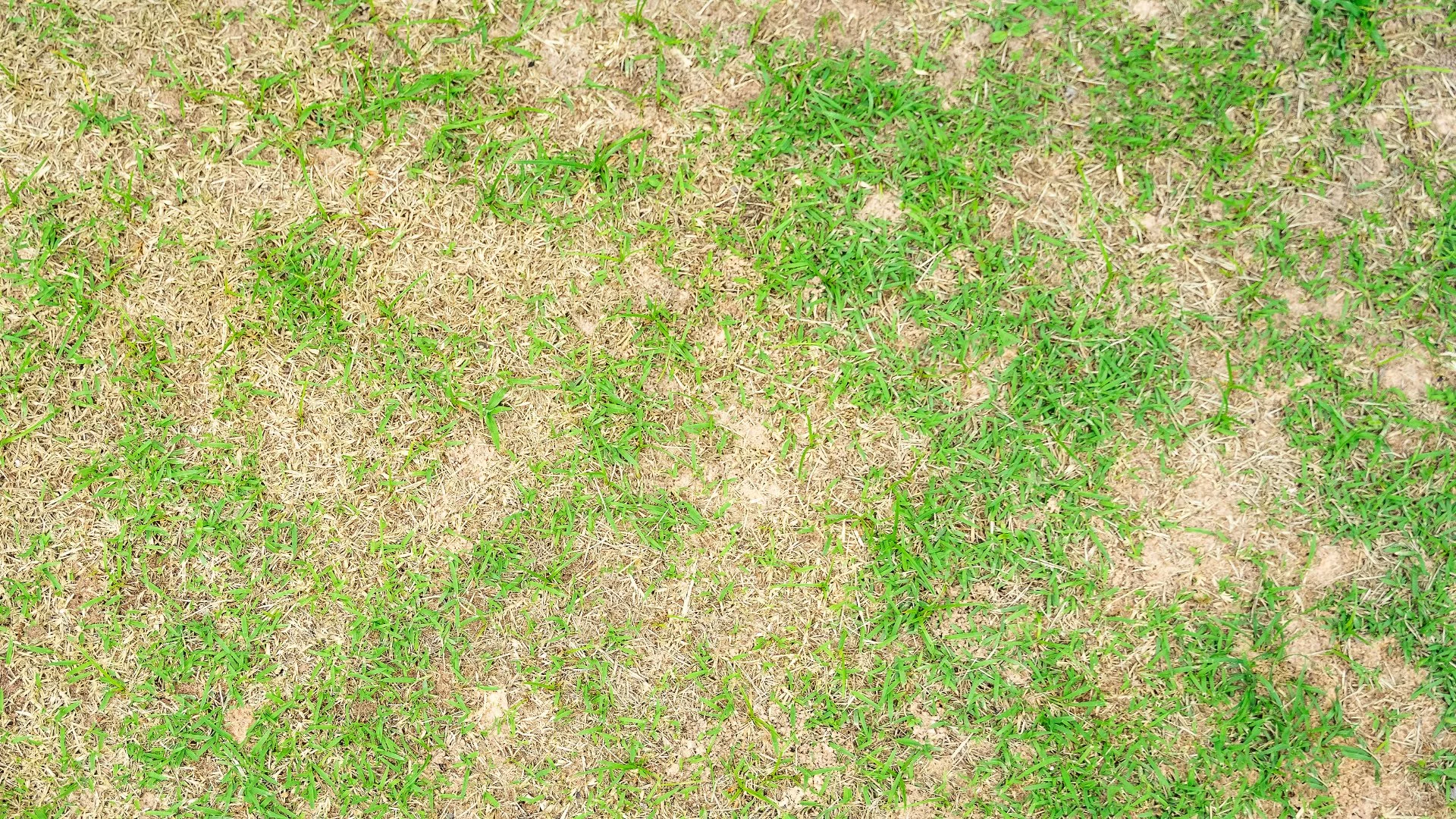
Stage one (early). Small patches of yellowing grass, usually three to six feet across, in the sunniest part of the lawn. Easy to mistake for early drought stress. Greens up slightly with a deep watering but does not fully recover.
Stage two (active). The yellow patches turn straw-colored to brown. New patches appear at the edges. Damaged areas connect into larger zones. The grass at the boundary between healthy and damaged is wilted even right after watering.
Stage three (advanced). Large brown areas, often connected across most of the affected zone, with grass that pulls up easily because the stems have been killed at the base. New growth from runners is being killed almost as soon as it appears. Recovery requires resodding or aggressive overseeding combined with treatment.
The lawns we save are the ones we catch at stage one or early stage two. The ones we resod are usually stage three by the time we arrive.
How Chinch Bug Damage Differs From Other Causes
Drought stress browns evenly across exposed parts of the yard and recovers quickly with deep watering. Chinch bug damage starts in irregular patches and gets worse despite watering.
Take-all root rot is also irregular but the grass pulls up easily because the roots are destroyed, not the stems. Chinch bug damaged grass pulls up easily too, but the soap test resolves the question in minutes.
Brown patch fungus is more circular and often has a gray smoky ring at the edge, especially on dewy mornings. Chinch bug patches are irregular and have no ring.
Grub damage shows up later in the season (August and September in our area), the grass lifts in big mats because the roots are gone, and you can find grubs by peeling back the sod. Chinch bug damage hits in June and July, the grass is killed from the stem down, and the bugs surface with the soap test.
What Treatment Looks Like
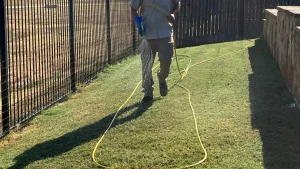
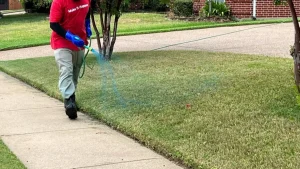
A confirmed chinch bug infestation gets treated with a targeted insecticide labeled for chinch bug control on warm season grass. The application has to reach the soil surface where the bugs live, not just the top of the canopy, so we water the lawn lightly before application to break surface tension and then water in after application to drive the product down. Most of the products labeled for chinch bugs in residential lawns provide three to six weeks of residual control.
For active outbreaks, one treatment usually stops the damage within five to seven days. A follow up application 21 to 28 days later catches the next generation as eggs hatch. After that, a preventive application in early June each year handles ongoing population pressure on susceptible lawns.
For lawns with a chinch bug history, preventive treatment in late May or early June is dramatically more cost effective than waiting for damage. We have customers in Keller and Aledo who used to lose 500 to 1,500 square feet of sod a year before they went on a preventive program. After the switch, they have not had a single replacement.
Recovery Timeline After Treatment
Treatment stops the spread but does not regrow what is already dead. Recovery depends on how much living tissue remains and how aggressive the property owner is on the recovery side.
Light damage (less than 10 percent of the lawn affected, mostly stage one). Two to four weeks of normal care and the area fills back in from surrounding runners.
Moderate damage (10 to 30 percent affected, mixed stage one and two). Four to eight weeks with deep watering, light fertilizer, and patience.
Heavy damage (more than 30 percent affected or significant stage three). Often requires sodding or plugging the worst areas plus several months of recovery. By the time you are in heavy damage territory, replacement is usually faster than waiting for runners to refill.
What to Do This Week
If your St. Augustine lawn has any yellowing or browning that has appeared in the last two weeks, do the soap flush test today. It costs nothing and either confirms a chinch bug problem or rules it out. If you find any, do not wait. Every day of delay means the damaged area expands.
If your lawn looks fine but you live in the area and you have had chinch bug issues in past years, this is the week for a preventive application. The window for prevention closes as June progresses.
What to Do Next
If you suspect chinch bugs and want a confirmed diagnosis, we will come walk the property, run our own soap test in multiple locations, and tell you exactly what we see. If treatment is needed, we can usually be on the schedule within a few days.
Call us at (817) 799-6823 or visit buffalooutdoor.com to request your quote. As the fastest growing and highest rated outdoor services company in Tarrant County, with awards including Best of Fort Worth in 2022, 2024, and 2025, and Inc. 5000 recognition in 2023, we bring a level of expertise and accountability that is hard to match. Our 100% satisfaction guarantee means if we cannot make it right, you pay nothing. We serve homeowners across Keller, Aledo, Saginaw, Benbrook, Fort Worth, Southlake, Roanoke, Trophy Club, North Richland Hills, and communities throughout the area.