Short Answer: June is the most important transition month of the year for Fort Worth area lawns. Between now and the end of the month, your lawn needs the right summer fertilizer step, an adjustment to deeper less frequent watering, a mowing height bump for both Bermuda and St. Augustine, a preventive insect application before chinch bugs and grubs hit peak activity, and a careful look at any thin or browning spots before triple digit heat exposes them. Lawns that get this list right in June are the ones that hold color and density through July and August. Lawns that skip June pay for it in September.
If you are reading this in early or mid June and your lawn still looks pretty good, that is the moment to act. North Texas summer is gentle to a healthy lawn and brutal to a stressed one, and the difference between those two outcomes is decided in the next three to four weeks. We want to walk you through exactly what we put on our crew’s clipboards in June, so you can either do it yourself or know what to look for from any service you hire.
This is a working checklist. Take it section by section. If you get even half of it right, your lawn will outperform most of the block by the time the 4th of July rolls around.
Week 1: Adjust Watering Before You Lose Roots
The first thing to fix is your sprinkler schedule. Most Fort Worth area lawns are running 15 minute cycles four or five mornings a week. That schedule is fine in April. It is a slow disaster in June. Short daily watering keeps the top inch of soil moist, which is exactly where you do not want your roots living when the heat sets in. By July the top inch dries out by 10 a.m. and shallow rooted grass starts wilting before lunch.
The fix is one inch of water per week, applied in two cycles, in the early morning. For most rotary heads that is about 45 minutes per zone twice a week. For fixed spray heads it is closer to 25 to 30 minutes twice a week. If you have clay or slope, use a cycle and soak pattern: three short cycles spaced an hour apart instead of one long run.
You want the screwdriver test to read clean. Push a long screwdriver into the lawn the morning after watering. It should slide in to six inches without a fight. If it stops at two, you are watering too shallow.
Week 1: Raise the Mowing Height
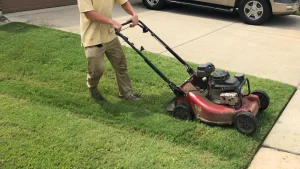
Bermuda lawns that ran at one and a half to two inches through spring should move to two and a half to three for the summer. St. Augustine should be at three and a half to four. Zoysia, three to three and a half. The taller cut shades the soil, reduces evaporation, encourages deeper rooting, and dramatically slows weed pressure.
The other half of mowing height is frequency. Never remove more than one third of the blade in a single cut. In June that usually means mowing every five to seven days for Bermuda and every seven to ten days for St. Augustine. Sharpen your blade if you have not already this season. A dull blade tears the leaf tip and gives the lawn a hazy white look two days after mowing, which is also a stress signal that helps disease move in.
Week 2: Summer Fertilizer (Carefully)
June is the right month for a summer feeding on Bermuda and St. Augustine, but the rate and product matter. Heavy nitrogen in late June pushes a flush of soft green growth that has no root depth behind it, and then the lawn collapses when temperatures hit the high 90s. We use a slow release formulation at a moderate rate, with potassium included to support heat and drought tolerance.
If you fertilize yourself, look for a product labeled for summer use on warm season grass, with a slow release nitrogen source (usually shown as polymer coated urea or sulfur coated urea on the bag). Apply at the lower end of the rate range. Water it in within 24 hours.
Avoid weed and feed combinations in June. Most contain herbicides that can damage warm season grass under heat stress, and they are usually formulated for cool season lawns anyway.
Week 2: Preventive Insect Application
This is the most overlooked step on the list. By the second half of June, chinch bug populations are building in Bermuda and St. Augustine across Tarrant County, and white grub adults (June bugs and Japanese beetles) are laying eggs in healthy irrigated lawns. Both pests cause visible damage in July and August, and both are far easier to prevent in June than to treat in late summer.
A preventive insecticide application on the lawn (we use a granular product designed for warm season grass) handles the early instars of chinch bugs and the white grub larvae that hatch in late summer. One application, done correctly, prevents most of the late summer damage we see on lawns that did not get it.
If you are uncertain whether you need this, the chinch bug damage we treated last summer in Fort Worth, Keller, and Aledo was almost entirely on properties that skipped the June preventive. That is the pattern, and it has held year over year.
Week 3: Diagnose Thin Spots Before They Spread
Walk your lawn slowly with a coffee. Look at any thin areas, browning edges, or spots where the grass is not filling back in after mowing. Six things create these patterns in our area: chinch bugs, take-all root rot, brown patch, drought stress, irrigation gaps, and shade progression. Each one looks slightly different and each one has a different fix.
Chinch bug damage starts in the hottest sunniest parts of the yard and expands outward as irregular brown patches. Take-all root rot patches are also irregular but the grass pulls up easily because the roots are gone. Brown patch is more circular and often has a smoky ring at the edge. Drought stress browns evenly in exposed areas. Irrigation gaps show up as predictable browning where coverage misses. Shade thinning happens in the same spots year over year.
If you are not sure what you are looking at, that is exactly the moment to have us walk the property. Diagnosing it correctly the first time costs nothing. Treating the wrong cause for two months costs more than the lawn.
Week 3: Tree and Shrub Inspection
While you are walking the property, look at your trees and major shrubs. June is when bagworms, scale, aphids, and webworm activity ramps up. Mature trees and ornamentals matter more to property value than turf does, and a small problem caught in June is usually a 30 minute treatment. The same problem in August can be a whole crown replacement project.
The signs to look for: stripped leaves at the top of evergreens (bagworms), sticky residue on lower foliage or under trees (aphids), small bumps or scale on twigs and stems (scale insects), and silken webs at branch tips (webworms). Any of those means it is time to schedule a treatment.
Week 4: Check Your Irrigation Coverage
Most yards have at least one zone that has drifted out of spec since installation. A misaligned head, a blocked spray pattern, a sunken rotor, a leaky valve. The result is a brown stripe or corner that nobody can explain.
Run each zone for two minutes mid morning and walk it. Look for heads that have rotated off pattern, areas that are getting hit twice, and any spots that are not getting any water at all. Small adjustments now save you the rescue work in August. While you are at it, make sure your rain sensor is functional (or install one if it is not) and confirm the controller is set to skip cycles after rainfall.
Week 4: Pre-July 4 Quick Wins
If you have guests coming for the holiday, here are the highest visibility quick fixes for the last week of June. Edge driveways, walkways, and beds. Refresh mulch in front beds. Pull or spot-treat any visible weeds in the most visible turf. Trim any branches that hang into the yard or block sightlines. Sharpen your mower blade if you have not already.
These are not lawn care fundamentals. They are cosmetic. But they are what makes a yard read as well-kept to visitors and neighbors, and they are easy to knock out in a Saturday afternoon.
The One Mistake That Undoes the Whole Month
If you only remember one thing from this checklist, remember this: do not panic-water in late June. Almost every lawn we rescue in August got there because the owner saw early heat stress, switched to daily watering, and trained the roots up to the surface where they could not survive. Stay on the deep infrequent schedule even when the lawn looks a little tired. The grass will recover overnight if the roots are deep. It will not recover if the roots are sitting in the top inch.
What to Do Next
If you want help working through any of this list, we are glad to come walk the property with you. We will look at your specific lawn, identify what is doing well and what needs attention, and tell you honestly which items on this checklist matter most for your situation.
Call us at (817) 799-6823 or visit buffalooutdoor.com to request your quote. As the fastest growing and highest rated outdoor services company in Tarrant County, with awards including Best of Fort Worth in 2022, 2024, and 2025, and Inc. 5000 recognition in 2023, we bring a level of expertise and accountability that is hard to match. Our 100% satisfaction guarantee means if we cannot make it right, you pay nothing. We serve homeowners across Keller, Aledo, Saginaw, Benbrook, Fort Worth, Southlake, Roanoke, Trophy Club, North Richland Hills, and communities throughout the area.